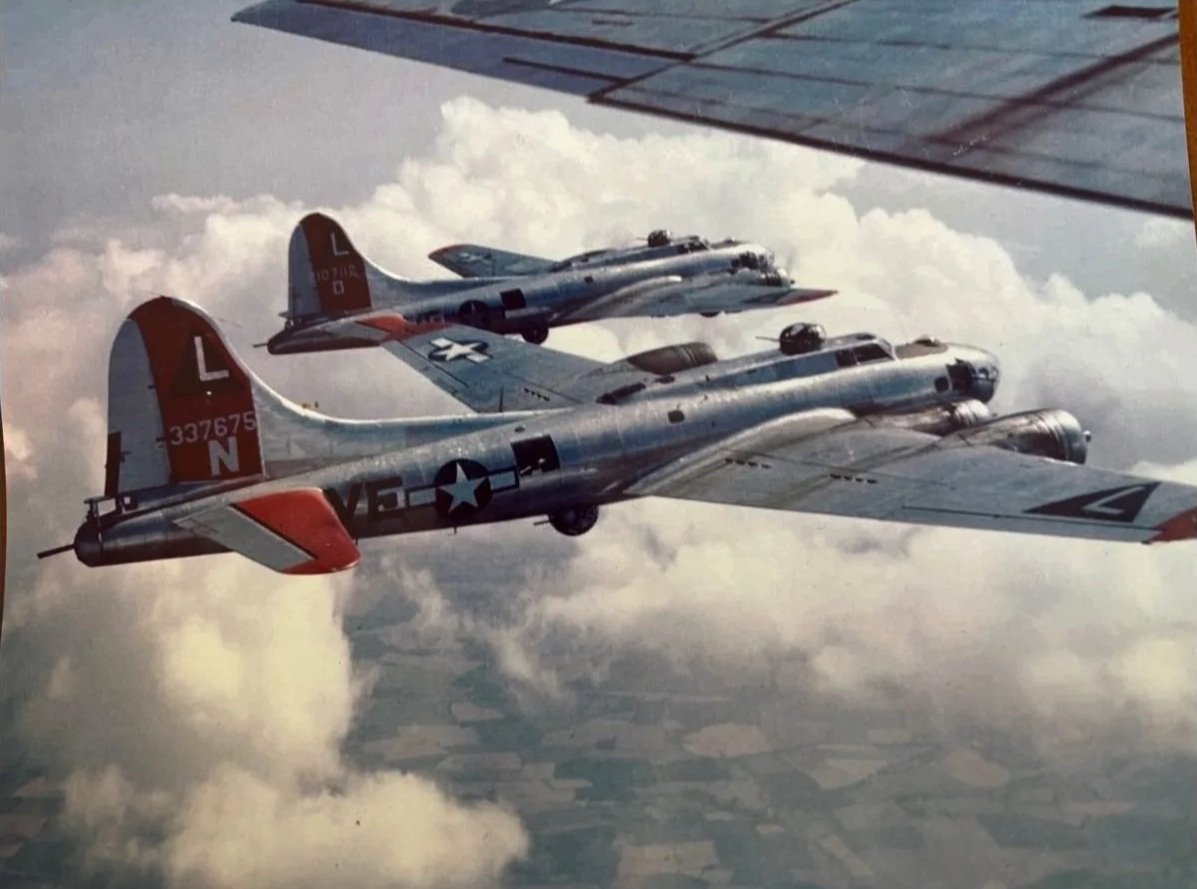
Captain Jack, A Bombardier’s Story
CAPTAIN JOHN A. MAGUIRE
United States Army Air Force · World War II
Dates of Service SPT 1942 – NOV 1945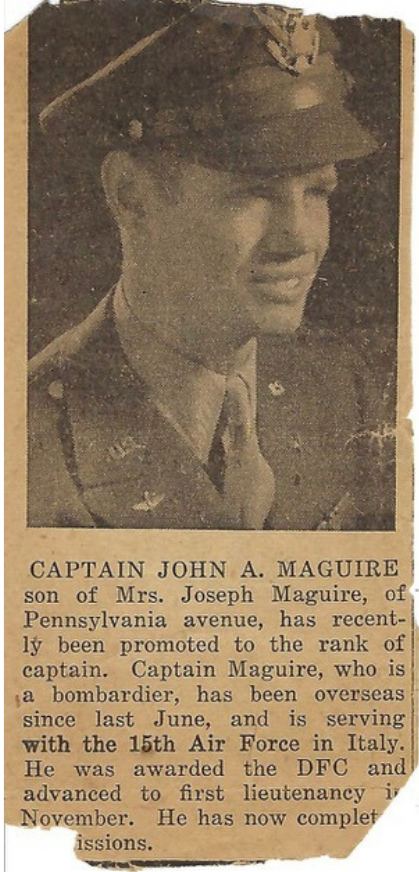
“I am writing this so that one day my grandkids can hear my story.”
— Jack Maguire
Son, Husband, Father, Grandfather, War Hero.
✦✦✦
May 23, 1920 — March 18, 1988
Wayne, Pennsylvania
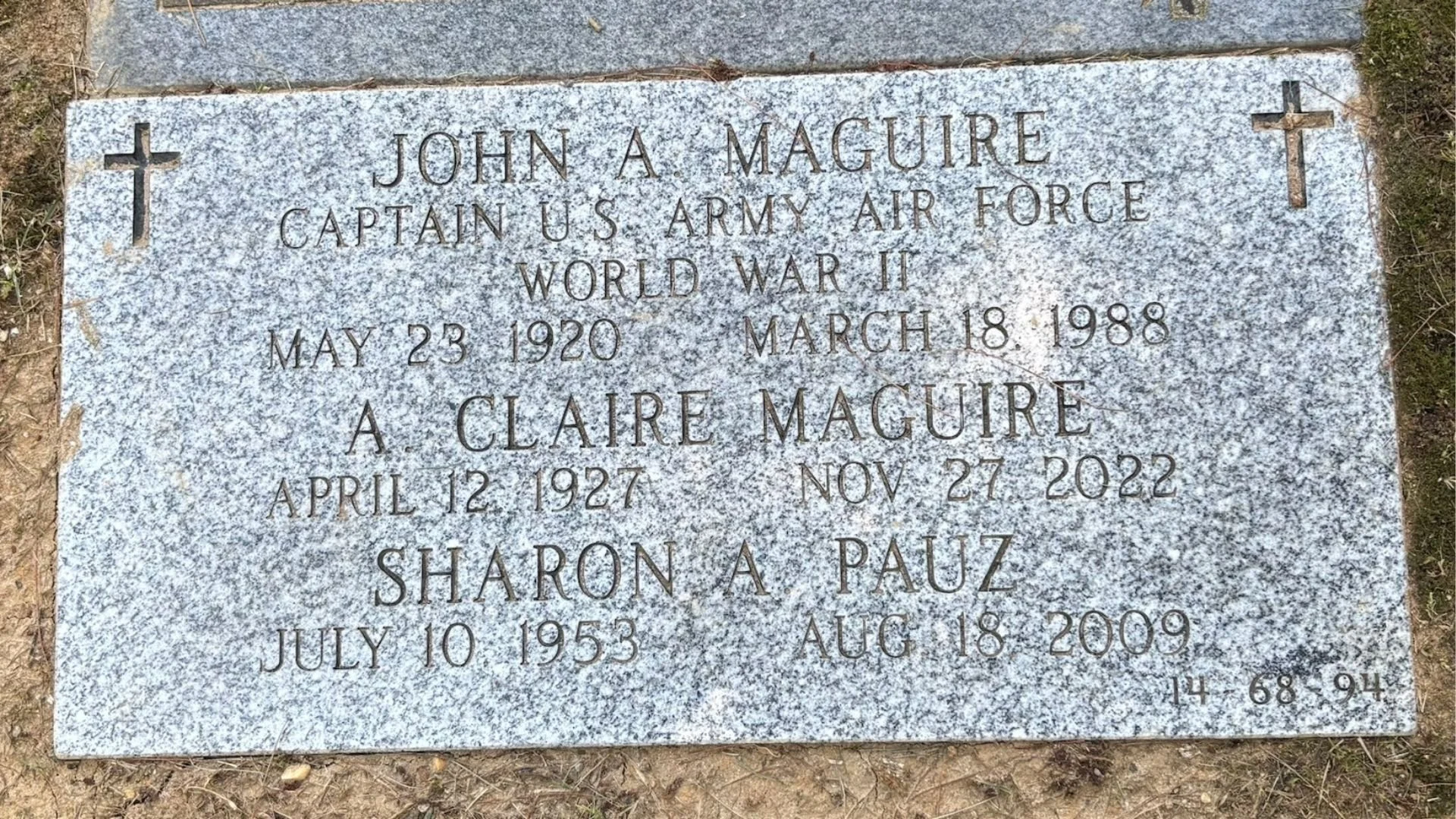
The gravestone of Captain John A. Maguire and A. Claire Maguire — "Captain U.S. Army Air Force, World War II."
Captain John A. Maguire died on March 18, 1988, at the age of 67. His wife, A. Claire Maguire, survived him and lived until November 27, 2022.
His gravestone records simply:
"Captain U.S. Army Air Force, World War II."
But there is so much more to the man.
Table of Contents
Foreword by Jim Maguire
I. Personal History
Early Life
Enlistment and Training
The Journey to War
II. The War
Assignment to Italy
The Crew — The “Hot Rocks”
The B-17 Flying Fortress — In His Own Words
The Role of the Bombardier
Mission Account: Ploesti — “The Most Heavily Defended Target in Europe” Mission Account: Belgrade — Earning the Distinguished Flying Cross Mission Account: Oswiecim (Auschwitz)
Formation Flying — Tail End Charlie
From Bombardier to Formation Commander
III. Official Mission Log
IV. Honors and Awards
V. The Cost — What It Took to Survive
“7 Planes, 5 Lost”
The Award Progression
General Orders #3212 — The July 1944 Ploesti Mission
VI. “How Many More?” — The Mission Quota and Morale
Combat Fatigue — “Flak Happy”
VII. Letters Home — Jack and Bobby and Anne
VIII. The War Ends for the Hot Rocks
The Hot Rocks — Counting Together, The Reunion
Return to Pennsylvania
Death
IX. Summary of Service
Foreword
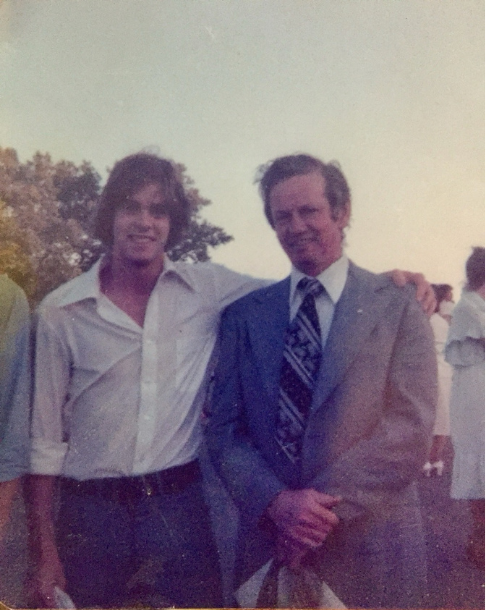
This is a history of the extraordinary life and World War 2 experiences of Captain John Anthony Maguire. This is compiled from original military records, personal correspondence, contemporaneous newspaper clippings, official citations, German documents and his own handwritten, recorded and typed memoir accounts written decades after the war.
Captain Maguire was a bombardier with the Fifteenth Army Air Force, 301st Bombardment Group, 352nd Bombardment Squadron, flying B-17 Flying Fortress aircraft out of Lucera, Italy, as part of the 15th Air Force's strategic bombing campaign over Occupied Europe, also known as the Mediterranean theater.
He flew 35 combat missions between June 1944 and April 1945, accumulating 278 hours and 30 minutes of combat flying time over some of the most heavily defended targets on the continent.
He came home. All ten men in his crew, the "Hot Rocks," came home. In the words of his crewmate Gene Reynolds: "We were the only crew I know of that came back without even a Purple Heart."
He returned to Pennsylvania, built a business, raised a family, and carried these memories with him for the rest of his life.
This memoir is something Dad started and tried to create many times over the years.
The memories and emotion ran so hot that he could barely get through a page, often stopping and walking down to Brennan’s bar to forget what he just tried to relive.
The documents and narrative gathered here are intended to preserve his story for the generations that follow. It has been a challenge and honor over the last few years to finish documenting the story that he lived. The experience that he survived is so big, so terrifying and he was so brave that it is hard to comprehend.
Truly, the greatest generation.
— Jim Maguire, 2026
Part I.
Personal History
Early Life
John Anthony Maguire was born on May 23, 1920, in Radnor, Delaware County, Pennsylvania. He grew up in Berwyn and Wayne, eventually at 135 Pennsylvania Avenue, Wayne. He is the son of Joseph R. and Bessie Maguire. He was one of 7, brothers.
The boys were Joseph (1918), Eugene (1919), John (1920); the girls Elizabeth (1922), Anna Virginia (?) , Roberta (1932), and Katharine Anne (1933).
He attended St. Katharine High School in Wayne and although he did not graduate high school, his Saint Katharine education served him well in his life and his natural intelligence enabled him to attain the rank of Captain in WW2, where what you did in combat mattered more than letters after your name.
Jack grew up in the middle of the great depression. His father Joseph died in 1937 from stomach cancer, further challenging the Maguire family. Jack’s mother Bessie was a single mom, in the great depression, with 7 children. An orphan herself, Bessie Maguire did a hell of a job and was the unifying force in the family.
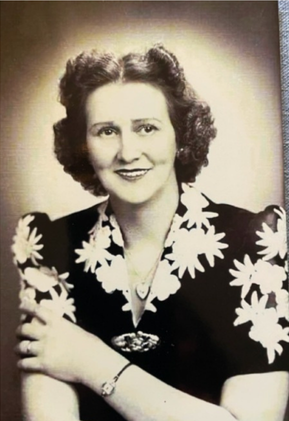
Bessie Maguire
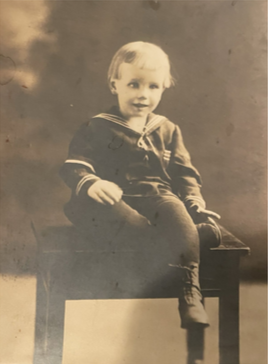
Jack Maguire as a toddler, 1923 — studio portrait in a sailor suit.
Before the war, John — known to friends and family as "Jack" — left Saint Katharine High School after his father’s death to help support the family. He worked at Bendix Aviation, located at 4700 Wissahickon Avenue in Philadelphia. There, he did production line work on aircraft turn-and-bank indicators, interpreted blueprints, and worked to written specifications. It was fitting preparation: the young machinist who built instruments for aircraft would soon be flying inside one of them, over the most dangerous airspace in Europe.
By 1940, Jack Maguire lived the life of a young man about town, with a good job, some cash in his pocket, girlfriends, golf and many buddies – in some ways an idyllic life. But as the events of the world unfolded, Pearl Harbor became the catalyst for the military mobilization of America and 22-year-old Jack Maguire was swept up in the patriotic fever.
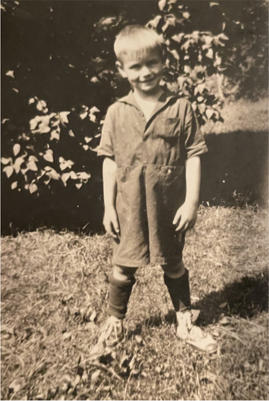
Jack as a young boy, circa 1926–1927 — already with that trademark smile and fashion sense.
Enlistment and Training
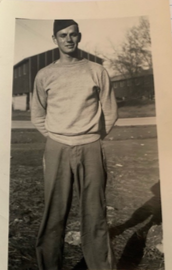
Maguire entered active service on September 19, 1942, and was assigned Army Serial Number O-762748. He was initially an enlisted man, and later was commissioned as an officer after completing training. He was a volunteer for the Army Air Force, as were all members of the AAF. As an Air Cadet, his training path took him across the country: Pilots Pre-Flight at Maxwell Field in Alabama (9 weeks, 1942); where he washed out as a pilot due to vision issues, Gunnery School at Tindell Field, Florida (6 weeks); and Advanced Bombardier training at Victorville, California (12 weeks).
A letter written from Maxwell Field in 1942, preserved in the family archive, captures the young Jack Maguire with characteristic humor. Describing his first day of physical training — a mile run to the athletic field, group exercises, then a mile back — he wrote home:
"The sun is really in my eyes. I'm not half dead. After I took a shower I really felt good." — Jack, Maxwell Field, Alabama, 1942
He was commissioned as a 2nd lieutenant in December 1943.
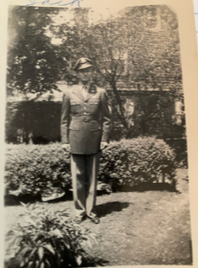
The Journey to War
The final entry in John Maguire’s stateside training record is dated April 26, 1944. His transfer
papers show him departing the 9th Processing center at Grand Island, Nebraska, bound for overseas deployment. He and his new crew, The Hot Rocks, had spent the previous weeks at the 224th AAF Base Unit in Sioux City, Iowa, forming as a crew and flying B-17F training missions — bomb trainer runs over the flat midwestern prairie, practicing the same procedures he would soon execute over Ploesti and Vienna. The certifying officer on his final training log was 2nd Lieutenant Robert C. Davis. It was the last American signature on his flight record for seven months.
From Nebraska, 2nd Lieutenant Jack Maguire traveled to Hampton Roads, Virginia, crossed the Atlantic by troopship through Gibraltar to Algiers, then on to Naples, and finally by train to Lucera, Italy. The journey took approximately six weeks. He arrived at the 352nd Bombardment Squadron, 301st Bomb Group on June 11, 1944 — two days later, the first training missions and eleven days until his first combat mission.
He was 24 years old. He had never been to Europe. Before the Army, he had hardly been out of the state of Pennsylvania.
Part II.
II. The War
Assignment to Italy
Second Lieutenant Maguire was assigned to the 352nd Bombardment Squadron, 301st Bombardment Group, on June 11, 1944. The 301st — one of the oldest B-17 groups in the Air Force — was stationed at Lucera, near Foggia in central Italy, as part of the 15th Air Force's 5th Bombardment Wing.
The military hierarchy was:
15th Army Air Force
5th Bomb Wing
301st Bomb Group (Heavy) Foggia, Italy
352th Bombardment Squadron Lucera Italy
In his own account, Captain Maguire later described life at the base with characteristic precision and dry humor:
"In central Italy between Foggia and Lucera, the 301 First Bomb Group was housed in an olive grove, a variety of tents. 352 squadron, and on a quonset hut the bulletin board displayed a variety of information — punishments for a variety of offenses, usually starting at twenty years."